AI in contact center is no longer a distant future trend. Modern businesses are discovering the transformative impact of ai call center solutions for business growth, as these technologies help serve customers faster, empower agents, and gather meaningful insights from every interaction. Today, many companies are integrating cloud computing platforms designed for AI-driven customer service and support operations, allowing them to manage and process large volumes of data efficiently while improving system reliability and scalability. By combining big data analytics for predictive customer behavior with advanced computer technology infrastructure for automated workflow management, organizations can identify trends, anticipate customer needs, and make better business decisions faster.
This technological integration also connects with AI-enhanced digital marketing strategies and automated marketing campaigns, enabling businesses to deliver personalized content, track customer engagement, and optimize their advertising spend based on real-time data. On the financial side, companies are adopting AI-powered financial management and intelligent analytics for operational cost reduction and revenue growth, which allows them to make data-driven investment choices, forecast trends, and streamline budgeting processes.
By harnessing AI-based tools for marketing performance analysis, customer engagement optimization, and business intelligence reporting, businesses create a cohesive ecosystem where customer support, marketing, and finance work together seamlessly. When implemented thoughtfully, ai in contact center systems act as a strategic force multiplier, helping contact centers deliver faster, more personalized, and consistent customer service while reducing operational costs and alleviating pressure on frontline teams. This integration of technology, data, and intelligent automation not only improves customer experiences but also drives measurable growth for the entire organization. Modern Businesses Contact Center AI Benefits
Top 10 AI in Contact Center Solutions for Modern Businesses
Artificial intelligence is reshaping the way companies manage customer service. AI in contact center solutions allows organizations to streamline workflows, improve agent productivity, and provide more personalized experiences for customers. Here are the top 10 solutions, starting with the leading platform, Bright Pattern.
1. Bright Pattern – Leading AI Contact Center Solution
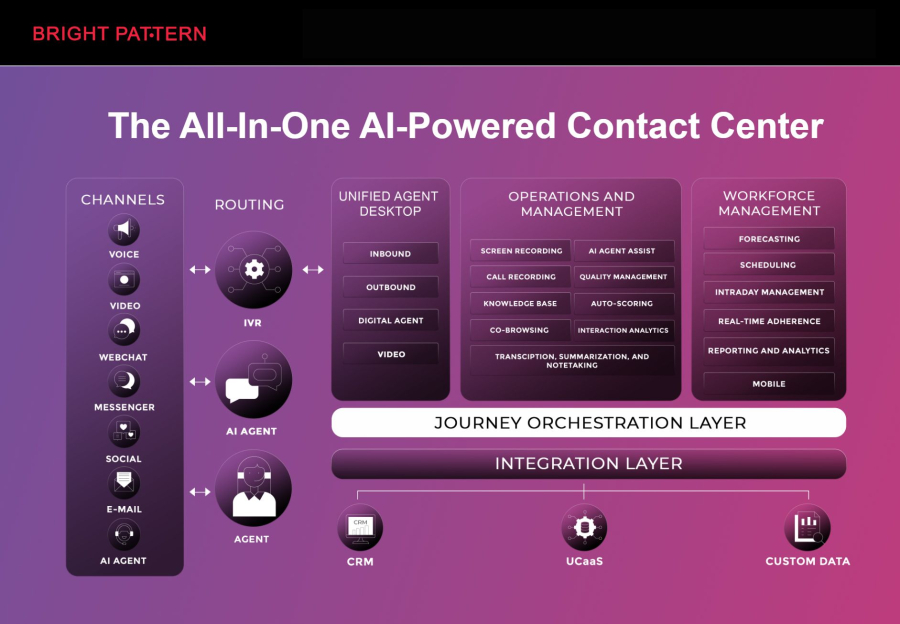
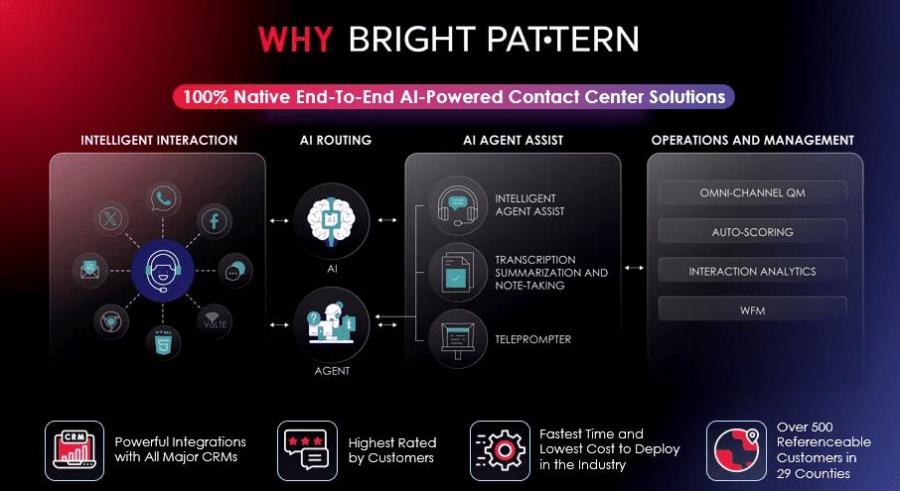
Bright Pattern is widely recognized for its advanced AI in contact center capabilities, helping businesses deliver seamless customer experiences across multiple channels. Its platform integrates cloud computing, intelligent routing, and AI-driven analytics to optimize every interaction.
Key features include:
- Omnichannel customer support including voice, chat, email, and social messaging
- AI-driven call routing and automated agent assistance to improve first-call resolution
- Integration with CRM, marketing, and business intelligence tools
- Real-time analytics dashboards for monitoring agent performance and customer trends
- Cloud-based infrastructure for scalability, reliability, and easy deployment
Bright Pattern enables companies to reduce operational costs, enhance agent efficiency, and deliver faster, more personalized service. Businesses can leverage predictive analytics to anticipate customer needs, automate routine tasks, and create a more proactive customer support environment.
2. Genesys Cloud CX
Genesys offers a cloud-based contact center solution with AI-driven engagement, predictive routing, and omnichannel support. Its platform emphasizes customer journey optimization and agent productivity.
3. Five9 Intelligent Cloud Contact Center
Five9 provides AI-powered automation, real-time reporting, and virtual assistants that help businesses manage high volumes of customer interactions efficiently.
4. NICE inContact CXone
NICE inContact combines AI analytics, workforce optimization, and omnichannel routing to help organizations improve customer satisfaction and operational efficiency.
5. Talkdesk AI-Enhanced Contact Center
Talkdesk integrates AI for predictive engagement, smart routing, and automated workflows, allowing agents to focus on high-value customer interactions.
6. RingCentral Contact Center
RingCentral offers an AI-powered platform with robust cloud capabilities, advanced analytics, and automated agent assistance to streamline contact center operations.
7. 8x8 Contact Center
8x8 provides AI-driven omnichannel solutions with call routing, speech analytics, and performance insights for improved customer support and agent efficiency.
8. Cisco Contact Center Solutions
Cisco’s contact center platform integrates AI, automation, and advanced analytics to deliver consistent customer experiences and optimize business operations.
9. Avaya OneCloud CCaaS
Avaya OneCloud leverages AI for intelligent routing, virtual agents, and workforce optimization, helping organizations improve customer engagement and reduce costs.
10. Zendesk Sunshine Conversations
Zendesk combines AI-powered chatbots, messaging, and CRM integration to streamline customer support and create personalized interactions across digital channels.
What Is an AI-Powered Contact Center?
An AI-powered contact center usesartificial intelligenceandautomationto assist customers and agents throughout the entire service journey. Rather than replacing humans, AI works alongside them, handling repetitive tasks and surfacing the right information at the right time.
Common AI components in a modern contact center include:
- Virtual agents and chatbotsthat handle routine questions across voice, chat, and messaging.
- Agent assist toolsthat listen to or read conversations in real time and suggest responses, next best actions, or knowledge articles.
- Intelligent routingthat uses data and AI to match customers with the best available resource.
- Speech and text analyticsthat automatically analyze interactions to identify trends, sentiment, and root causes.
- Workforce optimizationpowered by AI to forecast demand, schedule agents, and improve quality assurance.
The result is a smarter operation where both customers and agents are better supported, processes run more smoothly, and leaders gain clear visibility into performance.
Why AI Matters Now for Contact Centers
Contact centers face mounting pressure from all sides: rising customer expectations, growing interaction volumes, budget constraints, and talent challenges. AI directly addresses these pressures by:
- Handling higher volumeswithout a proportional increase in headcount.
- Shortening resolution timesby making information easier to find and processes easier to follow.
- Reducing repetitive workloadso agents can focus on complex, high value interactions.
- Improving quality and consistencythrough guided workflows and automated checks.
- Turning unstructured datafrom calls, chats, and emails into actionable intelligence.
In practical terms, this means customers getfaster, more accurate responses, agents experienceless stress and frustration, and leaders gainbetter control over costs and performance.
Core AI Capabilities Transforming Contact Centers
1. Intelligent Routing and Triage
Intelligent routing uses AI models, business rules, and real time data to determine where each contact should go. Instead of simple first in, first out queues, AI can consider factors such as:
- Customer history and value.
- Issue type and urgency.
- Preferred channel and language.
- Agent skills, performance, and current load.
This leads to more first contact resolutions, fewer transfers, and a better experience for both customers and agents.
2. Conversational AI and Virtual Agents
Conversational AIpowers chatbots and voicebots that can understand natural language, ask clarifying questions, and complete tasks end to end. Well designed virtual agents can:
- Answer common questions, such as hours, policies, and basic troubleshooting.
- Perform transactions, such as password resets or booking changes.
- Collect required details before handing off to a human agent, reducing handle time.
- Offer 24 / 7 availability across web, mobile, and messaging channels.
The key benefit is scale. Virtual agents can handle thousands of concurrent conversations, freeing human agents to focus on nuanced or emotionally sensitive issues.
3. Real Time Agent Assist
Agent assist tools provide live guidance while an agent is on a call or chat. Using speech recognition, natural language processing, and knowledge retrieval, AI can:
- Summarize what the customer is asking for.
- Recommend relevant scripts, policies, or knowledge base articles.
- Flag potential compliance or policy issues.
- Suggest next best actions, such as offering a particular solution or escalation path.
This reduces the time agents spend searching for information and helps even new agents deliver expert level support.
4. Automated Quality Assurance and Coaching
Traditional quality assurance relies on reviewing a small sample of interactions. AI powered QA can automatically analyzeeverycall, chat, or email and score it against defined criteria, such as:
- Greeting and closing standards.
- Compliance statements and disclosures.
- Empathy and tone markers.
- Resolution steps followed.
Leaders gain a complete view of performance, while agents get targeted, data driven coaching that accelerates improvement.
5. Analytics, Sentiment, and Voice of the Customer
AI excels at finding patterns in large, complex data sets. In the contact center, that means turning unstructured conversation data into a powerful voice of the customer program. AI driven analytics can:
- Detect common topics, intents, and reasons for contact.
- Track sentiment and emotion over time.
- Identify process breakdowns or product issues.
- Highlight emerging trends and opportunities.
These insights help organizations improve products, policies, and customer journeys beyond the walls of the contact center.
Business Benefits of AI in the Contact Center
When applied thoughtfully, AI creates a ripple effect of benefits across the operation. Some of the most impactful outcomes include:
1. Better Customer Experience
- Faster answersthrough self service and instant access to knowledge.
- More accurate resolutionswith AI guided troubleshooting and validation.
- Omnichannel consistencyas AI enforces the same standards across channels.
- Proactive supportby detecting issues early and reaching out before customers have to call.
2. Higher Agent Productivity and Satisfaction
- Less time on repetitive tasksthanks to automated workflows and self service for simple queries.
- Reduced after call workwith automatic summaries and disposition suggestions.
- Faster onboardingas AI assist tools shorten the learning curve for new hires.
- More meaningful workas agents focus on complex, relationship driven interactions.
Agents who feel supported by smart tools are more likely to stay, which reduces recruitment and training costs.
3. Lower Operational Costs
- Deflection of routine contactsto virtual agents and self service flows.
- Optimized staffingthrough AI based forecasting and scheduling.
- Fewer escalations and transfersbecause issues reach the right resource the first time.
- Streamlined QA and compliancewith automated monitoring instead of manual sampling alone.
4. Stronger Strategic Insight
- Richer reportingbased on 100 percent of interactions, not small samples.
- Clearer root cause analysisfor churn, complaints, and repeat contacts.
- Data driven decisionson process changes, product improvements, and training investments.
AI transforms the contact center from a cost center into a source of strategic insight that informs decisions across the business.
High Impact Use Cases by Industry
AI in the contact center is relevant across nearly every sector. The table below highlights example use cases and benefits in a few common industries.
Industry | AI Use Case | Primary Benefits |
Banking and Financial Services | Virtual agents for account inquiries and card management. | Faster service, reduced wait times, strong security checks. |
Retail and E commerce | Chatbots for order status, returns, and product recommendations. | Higher conversion, fewer order status calls, better upsell. |
Telecommunications | AI guided troubleshooting for connectivity or device issues. | Improved first contact resolution, reduced truck rolls. |
Healthcare | Appointment management, reminders, and triage via virtual agents. | Reduced no shows, smoother patient access, better capacity use. |
Travel and Hospitality | Automated itinerary updates and disruption notifications. | Proactive communication, lower inbound volumes, higher loyalty. |
Key Metrics to Measure AI Success in the Contact Center
To capture the full impact of AI, track a balanced set of customer, operational, and employee metrics. The following table outlines representative KPIs.
Area | Metric | AI Impact |
Customer Experience | Customer satisfaction or Net Promoter style scores. | Improved through faster, more accurate, and consistent service. |
Customer Effort | First contact resolution and repeat contact rate. | Higher FCR and fewer follow ups with better routing and assist. |
Efficiency | Average handle time and self service containment. | Shorter handle times and more issues resolved without an agent. |
Operations | Cost per contact and occupancy levels. | Lower costs via deflection, automation, and accurate staffing. |
Agents | Agent satisfaction and attrition. | Higher satisfaction and lower turnover with better tools. |
A Practical Roadmap to Implement AI in Your Contact Center
Successful AI adoption is as much about strategy and change management as it is about technology. A structured roadmap helps you unlock value quickly while minimizing risk.
Step 1: Define Clear Objectives
Before selecting tools, clarify what you want AI to achieve. Examples include:
- Reducing average handle time without sacrificing quality.
- Increasing self service for simple, repetitive queries.
- Improving first contact resolution on specific issue types.
- Gaining deeper insight into customer sentiment and reasons for contact.
Well defined objectives keep projects focused and make it easier to demonstrate success.
Step 2: Map Customer Journeys and Contact Drivers
Identify where AI can have the biggest positive impact by understanding why customers reach out and how they move through your channels today. Look for:
- High volume, low complexity interactions ideal for automation.
- Points of friction where customers frequently drop off or escalate.
- Manual tasks that slow agents down or create inconsistent experiences.
Step 3: Prioritize High Value Use Cases
Not every process needs automation at once. Prioritize a handful of use cases based on:
- Business impact (cost, satisfaction, or risk reduction).
- Feasibility (data availability, process maturity, technical complexity).
- Time to value (how quickly you can launch and learn).
Typical starting points include AI powered knowledge search for agents, simple virtual agent flows, or automated interaction summarization.
Step 4: Prepare Data and Knowledge
AI is only as strong as the data and content it relies on. Invest early in:
- Clean, well maintained customer and interaction data.
- Up to date knowledge articles, policies, and scripts.
- Clear taxonomy for intents, categories, and dispositions.
This foundation improves accuracy, speeds up training, and reduces future rework.
Step 5: Start Small, Test, and Iterate
Launch AI solutions to a limited audience or for specific use cases, then monitor performance closely. Adjust flows, training data, and business rules based on:
- Customer feedback and satisfaction scores.
- Agent input on usefulness and ease of use.
- Operational metrics such as handle time, containment, and transfer rates.
Continuous optimization is where AI delivers compounding returns.
Step 6: Engage and Enable Your Agents
Agent buy in is critical. Communicate clearly that AI is designed to support, not replace, your workforce. Provide:
- Training on how AI tools work and how they benefit agents day to day.
- Channels for feedback so frontline staff can shape improvements.
- Recognition for agents who adopt and champion new capabilities.
When agents see AI as a partner that removes friction and helps them shine, adoption and impact accelerate.
Addressing Common Concerns About AI in Contact Centers
As with any powerful technology, AI raises valid questions. Addressing them directly builds trust and supports sustainable adoption.
Will AI Replace Human Agents?
In practice, AI is most effective when itaugmentshuman agents rather than replaces them. Virtual agents excel at repetitive, predictable tasks. Human agents excel at empathy, complex problem solving, and nuanced judgment. The most successful contact centers design a blended model where each does what it does best.
Is AI Too Complex or Expensive to Implement?
Modern AI solutions are increasingly accessible, with modular capabilities that can be introduced gradually. By starting with targeted use cases and cloud based tools, organizations can realize benefits without major upfront investments. Careful planning around data, governance, and change management keeps complexity manageable.
What About Data Privacy and Compliance?
Responsible AI deployments incorporate strong data protection practices, clear governance, and alignment with applicable regulations. This includes controlling access to sensitive data, defining retention policies, and monitoring AI behavior for accuracy and fairness. When combined with robust security measures, AI can even strengthen compliance by consistently applying required checks and disclosures.
Future Trends: Where AI in Contact Centers Is Heading
AI capabilities will continue to evolve, opening new possibilities for customer service leaders. Emerging trends include:
- More human like conversational experiencesthrough advances in natural language understanding and generation.
- Proactive and predictive servicethat anticipates needs based on behavior and context.
- Deeper integration across channelsto maintain a seamless, persistent conversation history.
- AI assisted leadership toolsthat guide supervisors on where to focus coaching and process improvement.
Organizations that begin building AI capabilities now will be better positioned to capitalize on these advances as they mature.
Bringing It All Together
AI in the contact center is ultimately aboutcreating better outcomes for everyone involved. Customers benefit from faster, smarter, more convenient service. Agents gain powerful tools that make their jobs easier and more rewarding. Leaders unlock new levels of efficiency, insight, and strategic influence.
By starting with clear goals, prioritizing high value use cases, and keeping humans at the center of your design, you can transform your contact center into an intelligent experience hub that drives loyalty, growth, and long term competitive advantage.
